Monday, April 4, 2011

Giant hands part 1

This is a picture of the beginnings of a very big project.
The goal is to make four pairs of articulated giant hands. They needed to be light enough to be operated easily by actors in a fight scene. Two pairs needed to go from an open hand to a fist and two of them needed to point.
I used the basic measurements of my hands and multiplied by three. I then spent a long day at the chop saw cutting three finger bones and one hand bone for each of the 40 fingers
For the joints of the fingers I used the nuts from toggle bolts.
I pre-drilled through the PVC and the toggle nut (be careful, you might want to use something besides your hand to hold the toggle nut down while drilling into it), then I screwed them together. At first it looked like the screws were going to hold, but I later had to replace some of the joints with machine screws and nuts because the screws worked their way loose.
The springs in the toggle nut are strong enough to make some of the finger tip joints spring back on their own, but the ones closer to the knuckle need some help from gravity to open back up.
 After assembling all the fingers (with a lot of help from some awesome students) they were screwed to 1x4 bases
The inside of the base was filled with upholstery foam to sandwich the hand and make the pieces easier to control.
In an upcoming post I will show how we finish the framework of the hand, cover them with skin and rig them up to move easily and consistently. But for now check out the effect of the giant hands.

Wednesday, March 16, 2011

The Seedling Mile sign

When we were one week away from tech for Leaving Iowa, the director decided that one of the road signs we were planning on doing as a projection, would work better as a practical prop.
It needed to be light, easy to move, and look like this.

I kinda freaked out. I imagined hours and hours of careful stenciling to get all of that wording onto the sign, and I didn't have enough time left for that.
My brilliant production manager came to the rescue, however, and suggested foam craft letters. Perfect solution.

The base of the sign is just a sheet of pink insulation foam, screwed to a PVC stand and coated in a home made scenic dope (a mixture of latex paint, latex caulk and drywall mud).

I sorted the letters into piles to make it easier to form words (this was the most time consuming part) and hot glued the words from the research image onto my sign. I then used a foam brush to brush a copper paint over the letters. Since the letters were raised, very little of the paint got on the brown sign behind the letters and I only needed to touch up a few places.
As a quick solution for getting the smooth copper line around the border I painted strips of spike tape and stuck them to the sign.
From the front it looked really impressive, and thankfully that was how the audience saw it, because if you get a view from the side you can still see the edges of my multi-colored foam letters.

Monday, March 14, 2011

Juke Box Rehab

I rented this juke box for a production of Always Patsy Cline. It's a great piece, mostly hollowed out, with a doors to make it look like an old 1950's fridge on the back (so we can shift easily from bar to kitchen). It has, however, seen better days and it needed a lot of love before I could put it on stage. 
The biggest problem was the four plastic panels on the front. The top two were plexiglass, painted with gold stripes and so full of cracks that they were pretty much laminated together with packing tape.
The bottom panels were made of corrugated plastic (which I am fairly sure was not the original material, but a fix someone had used in a previous show). It had scratches and paint marks all over it.

To replace them I needed something translucent, but I didn't want to go transparent (you can see in the previous images that the red party bulbs were visible behind the cracked plexiglass).
My first thought was to go with muslin, and to paint some sort of gold pattern onto it to break up the large expanses of white.
When I ran that idea past the set designer he suggested that maybe instead of painting we use radiator screen to get our pattern and provide us with a more rigid structure.
Radiator screen is a thin patterned metal available at most hardware stores. It is easy to cut with a pair of tin-snips and comes in a variety of patterns. It is not especially cheap ($30-$40 per sheet), but I was planning on making an investment in this prop so I could afford two sheets for this project.
I traced the pieces I was replacing onto the screen and cut them out.
Then I used spray adhesive to laminate some white taffeta I found in stock onto the back.
The hardest part was inserting them because they fit so tightly and the curves were awkward
On the plus side, the fit was so tight that once I got the pieces in, all I needed was a little hot glue to hold it there. Hot glue was also preferable because when I return the prop, if they decide to go back to the plexi panels, it should be able to pull right off of the metal without doing any permanent damage.
There are a few dents and creases in the screen that I couldn't get rid of, and I'm not sure how I could have avoided them considering all the twisting and pulling that was required to get the pieces in place.
But once the lights are on you hardly notice, and I think it turned out pretty well.

Friday, March 4, 2011

Proppeople.com

Hey everyone, just a quick note to let people know they should check out the prop people discussion forum.
The site (a part of the delphi forums site) had fallen pretty dead in the last year or two, but it looks as if Eric Hart (who write his own props blog at props.eric-hart.com) has taken over the project and is trying to get it up and running again. Here's hoping it's a success and we will again have a productive forum for asking questions, finding rentals, and sharing tricks.

And thanks Eric for taking on the challenge.

Wednesday, February 23, 2011

Book filling stamp

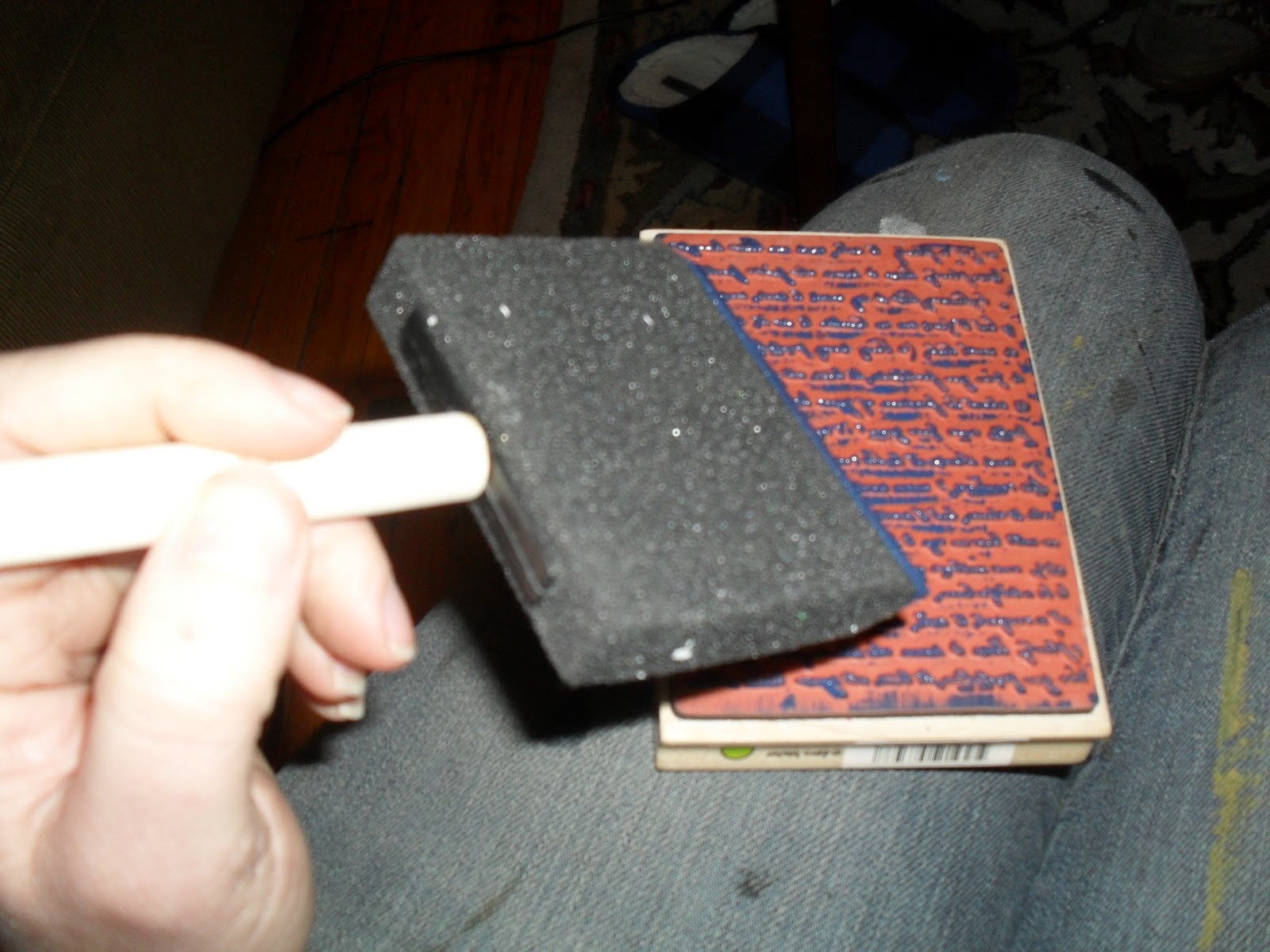
If you have never used one, I have to recommend that you purchase one or more of these stamps. 
brush on some paint (or ink from a stamp pad)
and press down into the book.
We wanted to leave the book blank in places so that the actors could write in it during rehearsals and fill pages with drawings, but it's a big book to fill.
A couple of stamps every few pages went a long way toward helping the book look full.
The process was also helped by my heat gun. I was able to stamp, dry and turn the page quickly and easily.

This project was for a show my fiance is working on, but I'm glad that I got a chance to use the stamp. I have a project coming up in the summer that is going to need a messy journal, I am thinking I might buy a second one (the craft stores sell multiple varieties) to get some length and width variety to the passages.

Monday, February 14, 2011

How theatre changes the world

I believe that arts can change the world. That is why I do what I do (besides having a ton of fun doing it). I believe that the arts are important. After a conversation with a friend tonight though I have decided that there is a need for me to further articulate that idea. It is no good for me (and my fellow artists) to just talk about whether arts make a difference; we have to specify how  they make a difference.

The scientific basis for my thoughts comes from a psychological research tool called an implicit association test (or IAT). These tests ask people to group sets of words as quickly as possible. For example I just took an IAT that asked me to click the "e" if I was presented with a "male" word (father, son, uncle, boy, etc.) and the "i" key if I was presented with a "female" word (mother, daughter, aunt, girl, etc. ). I was then presented with a series of words that were either liberal arts or sciences. Finally I was asked to do the two sets of words in conjunction; press "i" for male or science and "e" for female or liberal arts. Later the combinations were switched with female and science grouped together and male grouped with liberal arts. The idea is that by measuring how quickly I complete each task and how many mistakes I make, assumptions can be drawn about how closely I associate women with the arts and men with the sciences. In other words, to reveal my subconscious prejudices. This gender study is only one of many IATs looking into opinions about race, ethnicity, age, culture, sexuality and lots of other cultural markers. If you would like to learn more about these tests, or take a few, you should check out Project Implicit.

In one of my classes in college (I can't seem to recall which specifically) we were discussing implicit association tests and the professor told us a story of a man who took a test on race and was upset at his results. The results told him that he had a strong association of Caucasian with good and African American with bad. He took IAT over and over again trying to improve his results and had no luck. Then one day the results changed, and his score improved. In reflecting on what could have changed that day to alter his score he noted that he had spent most of the day watching the Olympics. All day long he had been seeing positive images of African American athletes overcoming challenges, working hard and succeeding. After that influence it was much more natural for his brain to associate African American with good when he was asked to do so.

I believe that arts can change the world because art can change people, but I don't think this change happens radically or quickly or even noticeably (at least in most cases).  I think the arts change people by exposing them to new ideas, foreign places, and unknown cultures. I believe and hope that the people who come see the productions that I am a part of, leave with just a little more understanding of the people and cultures and ideas that piece of theatre explored. I doubt that the change would be dramatic enough that the people in the audience would notice it, but if their metaphoric IAT score changed by just a point or two, that's progress.

My vision of a better world is based on the golden rule of treating others as you would like to be treated. I believe that treating others with respect comes from tolerance of difference, and tolerance comes from knowledge, and knowledge comes from exposure. The theatre is a place where we can be exposed to foreign ideas in a safe environment. Hopefully, eventually, that exposure leads to more tolerance worldwide and the ability to work together with respect and kindness to create a better world.

Tuesday, February 8, 2011

Lessons about Polaroids

Recently I worked on a show that calls for a Polaroid photo to be taken in the final scene. There really were no shortcuts available either to get around spending the money on the consumable prop of film for each performance. The photo is taken in full view of the audience and then one character is immediately asked to sign the bottom of the photo after the camera spits it out.

I acquired a working 600 land camera (popular in the 70s and 80s) and then started trying to find film. Turns out...way harder than you would imagine.

First, Polaroid stopped making film for its instant cameras in 2008. Fujifilm has since taken over production of some instant film, but as far as the camera professionals I talked to could tell me, they don't work in older Polaroid cameras and are mostly just for Fujifilm cameras.

To get the film you have two options. The first is ebay, where bidding is competitive for old expired polaroid film. I thought that this would be a good option for me. I figured the chemicals for developing the photos in the expired film might have degraded over time, but since I didn't need a quality image, I should be fine. The problem is that the battery in old Polaroid cameras is part of the film pack and the battery had degraded over time as well. After spitting out half of the photos in the pack, the battery went dead and the remainder of the pack had to be thrown away.

A second option is the-impossible-project, a company made up of former Polaroid employees working in an old Polaroid factory in the Netherlands. For the past few years they have been working to combine their knowledge to reinvent instant film. Their products are still growing and developing (for example they don't have the peel off guard old Polaroid film had. You have to shade the picture immediately as it is being spit out of the camera to avoid over exposure). Typically a downside of this film is the time it takes to ship, but I was lucky (I thought) to find a local camera store that buys it and keeps it in stock. In the end, the impossible film I purchased from the local store had the same problem as the ebay film. It had been sitting too long and the battery went dead after only taking six out of the eight photos in the pack. I would be interested in how film direct from the Netherlands would have held up.

So for future reference, plan on spending around $4 per photo if you need Polaroids, and allow plenty of time for ebay bidding and overseas shipping. If I had to do it again I think I would take my chances with the impossible project as I imagine their products are only going to get better with time.

Friday, February 4, 2011

Soap Cake

In The New Electric Ballroom, the script calls for a beautiful coffee cake to get smashed every night of the show. I was looking for a way to do that cheaply without having to bake three cakes per weekend (at $3 per cake with mix and eggs that can add up quickly). I had read once about people making snowballs from shaved soap and thought I might be able to use the same technique.

I bought cheap yellow bars of soap, then used my cheese grater to shred the bars into a bowl.
I carefully poured the shavings into my pan and packed them in, but they weren't packing very tightly. They still seemed very grainy and loose in the pan
I turned it over and sure enough I was right. the shredded soap didn't hold together at all and I just had a pile of flakes. 
I decided to add some water to make the soap stickier, so I packed the flakes in again and poured some water into the pan. TOO MUCH. 
I ended up with a gooey sticky mess that I had to throw away. Turns out the water thing requires a much lighter touch. 

My next solution was to spray the pan with water and then periodically spray the soap as I was filling the pan before packing another layer. I thought that the water on the outside would help the soap be especially sticky on the shell of the cake where I needed it to be. As is turns out, the water on the outside just made the soap especially stick to the pan.
The final solution was Pam to make sure that the soap didn't stick to the pan. 
and then slowly adding water to the mix (with a spray bottle this time) until the soap was ready to stick to itself. 
As a side note, you can see here why people use this method for snow balls, they ball up perfectly and I'm sure they would explode on impact.
I packed the soap into the pan again
and then turned it over and hit it with one good whack on the pan to release it
This one cracked a little getting it out, but you get the idea. 

This cake ended up getting cut because it was hard to clean up after being smashed in the middle of the floor, and because someone in the company offered to make a cake every night for the run. It's a really cool trick though and I think that it might have lots of applications in future shows.